Cobbler’s Kids
How I built a working content engine for a lean agency — in one quarter
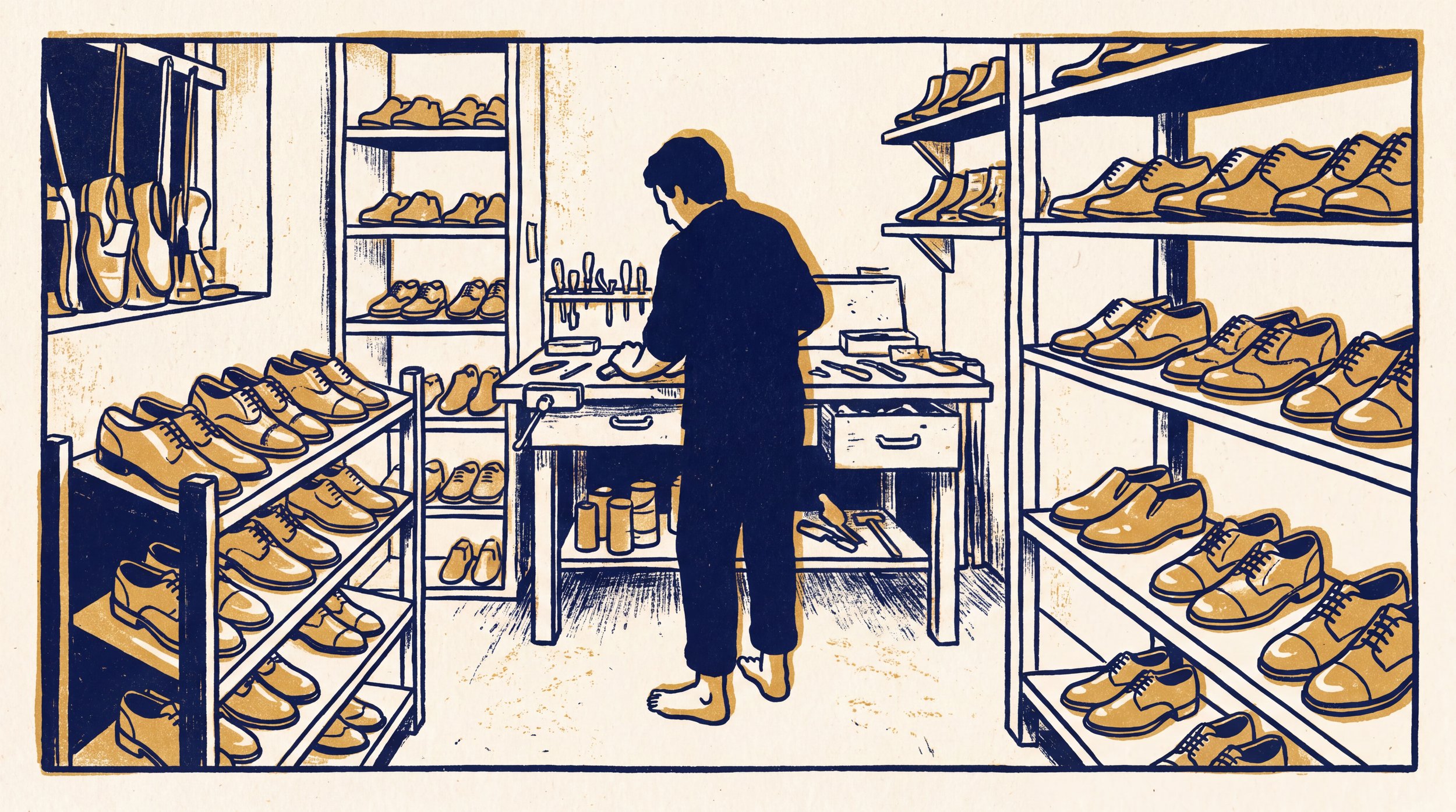
Some of the best marketers I know can't market themselves. Not won't — can't. The work goes to the clients who pay, their own presence goes quiet, and one day they look up and the sharpest voice in the building has been invisible for a year.
That's where this one started.
THE SITUATION
A lean, senior-practitioner marketing agency — two decades in business, hundreds of brands behind it, a founder who'd built the whole thing on doing more with less — had become the cobbler's kids. It could build a sharp content program for anyone on its roster, but its own presence had gone quiet. The most credible voice in the building belonged to the founder, and almost no one outside the building ever heard it.
The agency didn't need convincing that content mattered. It needed someone to make it a system instead of an occasional good intention — before the distance between how good the work was and how little anyone saw it started to cost them.
THE PROBLEM, STATED PLAINLY
Underneath the quiet was a set of specific gaps. Everything ran on one channel, posted in fits and starts. No editorial strategy telling it what to say, or why. No measurement, so no way to separate what worked from what didn't. The founder's twenty years of judgment — the single most differentiating thing the firm had — wasn't showing up anywhere a prospect would see it. And with a small, stretched team, anything that took ongoing effort slid to the bottom of the list the moment client work got busy.
No engine. Just effort, applied unevenly, with no way to know if it mattered.
WHAT I BUILT
I came in as an embedded content director and treated it as a system to build, not a queue of posts to fill. In one quarter I built:
A content engine with a repeatable logic. Every piece was designed to do one of three jobs — build trust, show how the firm thinks, or prove it works — mixed on a consistent weekly cadence so the program ran whether or not anyone felt inspired that week.
A strategy document that actually governed the work. Positioning, audience, content pillars, and a defined voice — written down and used — so the content stopped being a matter of taste and became a matter of plan.
Measurement that closed the loop. A scorecard and a monthly reporting rhythm that turned “that one did well, I think” into a real read on what to do next.
A founder-voice system. The founder's perspective was the asset; the bottleneck was getting it out of his head consistently. I built him a way to produce on-brand content in his own voice, so the firm's presence didn't depend entirely on me.
The operational spine. Writer and designer coordination, brief-and-review cycles, calendar discipline — the unglamorous machinery that makes a program read as one coherent thing instead of a pile of posts.
A next-phase plan. By the end, a clear roadmap for widening reach beyond the single channel: an owned audience, the founder out front, and presence in rooms the algorithm couldn't reach.
WHAT IT PRODUCED
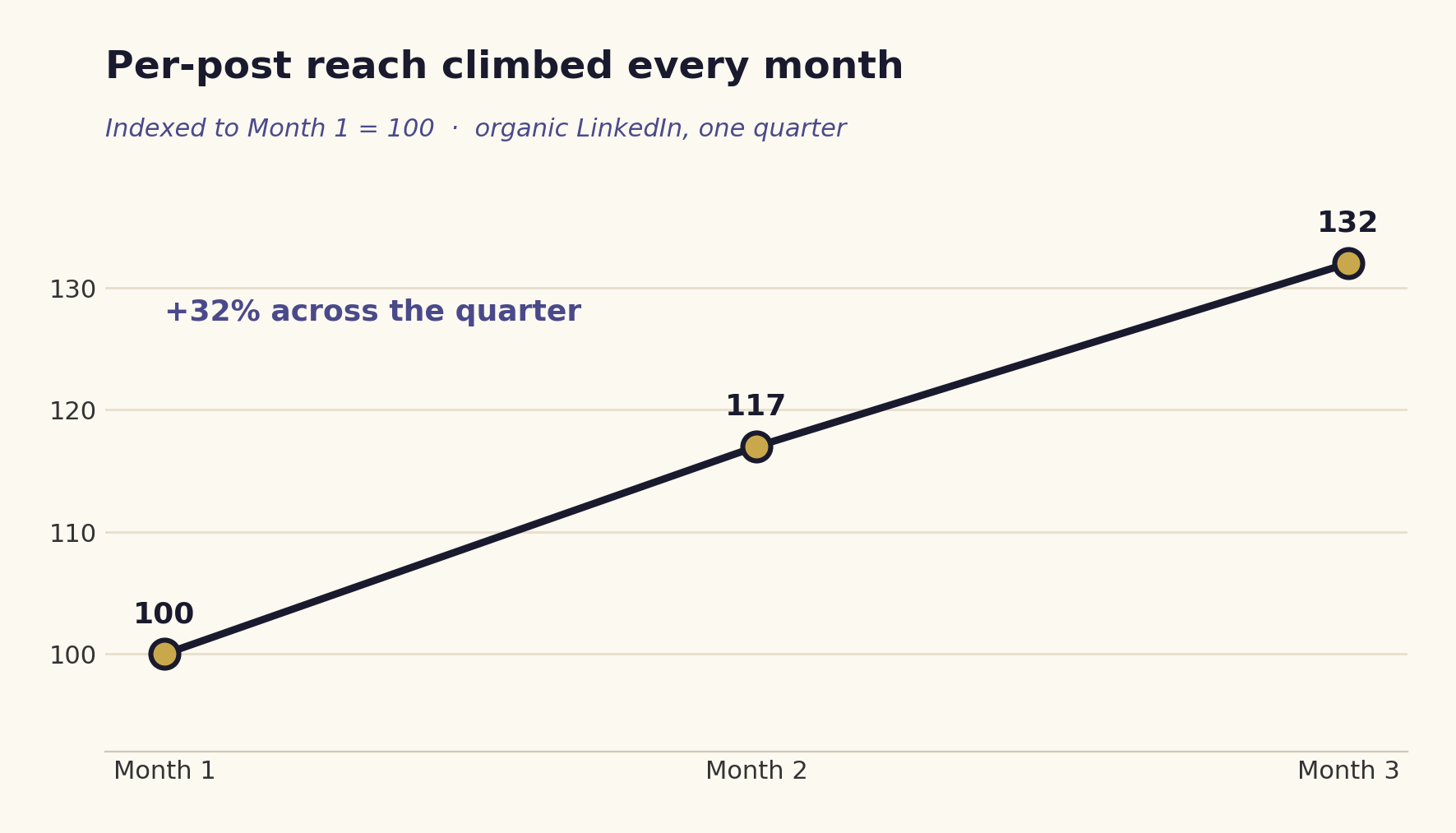
This was a foundation-building engagement, and I'll be straight about the shape of it: organic B2B content compounds slowly, and the first phase is about proving the engine works before the bigger results arrive. On that score, the signals were real:
Per-post reach climbed every month — roughly a third higher across the quarter — off nothing but a disciplined, strategic program.
The strongest month of the program to date landed inside the engagement.
A breakout format emerged — one carousel drew engagement and click-through several times the program's norm — handing the team a repeatable play, not a one-off.
The founder's own presence came to life, measurably out-posting a direct competitor.
The voice system outlasted the engagement. The clearest proof the work took: the founder kept producing in it after I rolled off. The engine didn't leave when I did.
What I won't claim: this wasn't the phase where a lead pipeline shows up — that's what the next phase was built for. But an agency that started with sporadic posting and no strategy ended the quarter with a running engine, rising reach, a founder finding his voice, and a plan for what came next. That's what a foundation is supposed to look like.
WHAT IT DEMONSTRATES
The reason to bring in a senior operator instead of a task-taker is what happens when reality intrudes — and it did. A testimonial fell through. Technical roadblocks stalled a launch. The founder was running a business and rarely had time to pre-read some things. None of it stopped the program, because handling that is the job.
Anyone can execute a clean brief. The value is in the person who can walk into ambiguity, impose a system, keep it running through the curveballs, and leave the client better equipped than when they found them.
If your firm has real expertise and no engine to show it off — if you're the cobbler's kids — that's the gap I close.
5th House Leo builds and runs content programs for firms that know their work is good and need the world to see it.
